
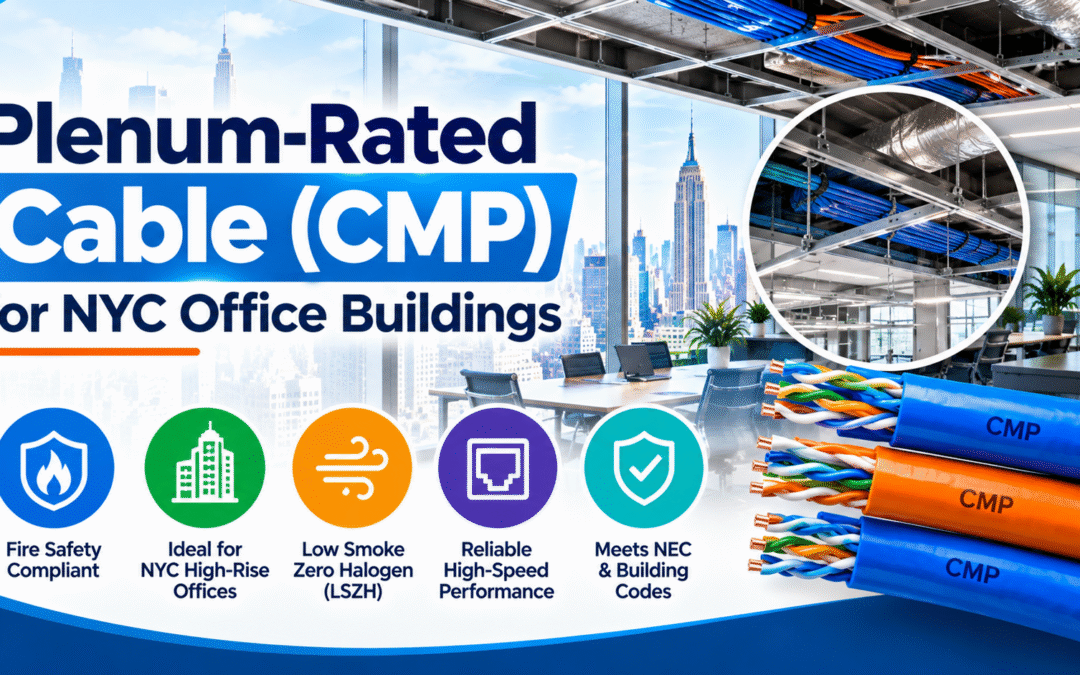
Plenum-Rated Cable (CMP) for NYC Office Buildings: The Complete Guide
Everything a Manhattan IT manager, property manager or contractor needs to know about choosing, installing and documenting CMP cable above ceilings, under floors and in air-handling spaces.
QUICK ANSWER
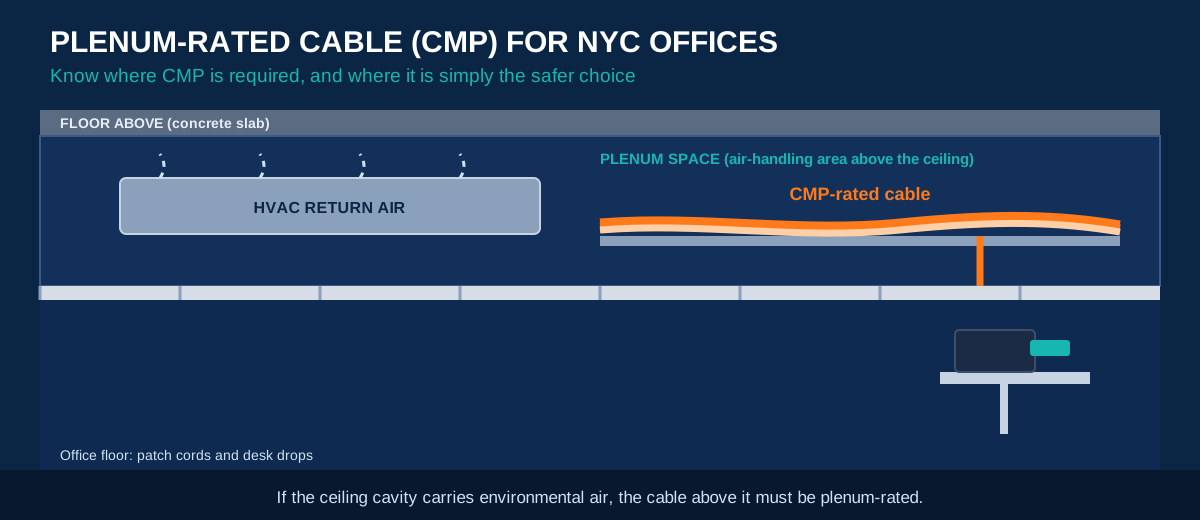
CMP is the communications cable rating for plenum spaces, the air-handling areas above ceilings and below floors. Its low-smoke, flame-retardant jacket is tested to UL 910 or the equivalent NFPA 262 method. In an office building, any data cable that runs through a space used for environmental air must carry the CMP marking, and CMP can also be used in place of riser (CMR) or general-purpose (CM) cable.
If you are planning a build-out, a tenant move or a network upgrade in a Manhattan tower, plenum-rated cable (CMP) for NYC office buildings is one of the first specifications to settle. The wrong jacket can fail a building review, delay a move-in and force a costly re-pull above a finished ceiling. This guide explains what CMP is, how it compares with CM and CMR, how New York conditions affect the choice and how to install it correctly.
Key Takeaways
- A plenum is any space that forms part of the air-distribution system, and cable in it must be plenum-rated.
- CMP can replace CMR and CM, but CMR and CM can never replace CMP in a plenum.
- Plenum cable costs more and is stiffer, so plan bend radius, support and budget early.
- Different cable families have different plenum markings: CMP, OFNP, CL2P/CL3P, FPLP and CATVP.
- In New York, building management rules often matter as much as the code, so confirm access, insurance and work hours before ordering.
In This Guide
- What is plenum-rated cable (CMP)?
- CMP vs CMR vs CM
- What applies in NYC office buildings
- Plenum markings for every cable type
- Cost, flexibility and installation
- Pre-order checklist
- Common mistakes
- Hiring a cabling contractor
- FAQ
What Is Plenum-Rated Cable (CMP)?
CMP stands for Communications Multipurpose Cable, Plenum. It is the highest of the three common communications fire ratings defined under Article 800 of the National Electrical Code (NEC), published by NFPA. The rating exists because a fire in an air-handling space can push smoke and toxic fumes through the whole building’s ventilation system.
What is a plenum space?
The NEC describes a plenum as a compartment or chamber connected to one or more air ducts that forms part of the air-distribution system. In an office, that usually means a ceiling cavity used as a return-air path, a raised floor used to move air, or an open air-handling room. A ceiling void with fully ducted returns is a different case, which is why the first job is always to confirm how the space is used.
How CMP cable is built
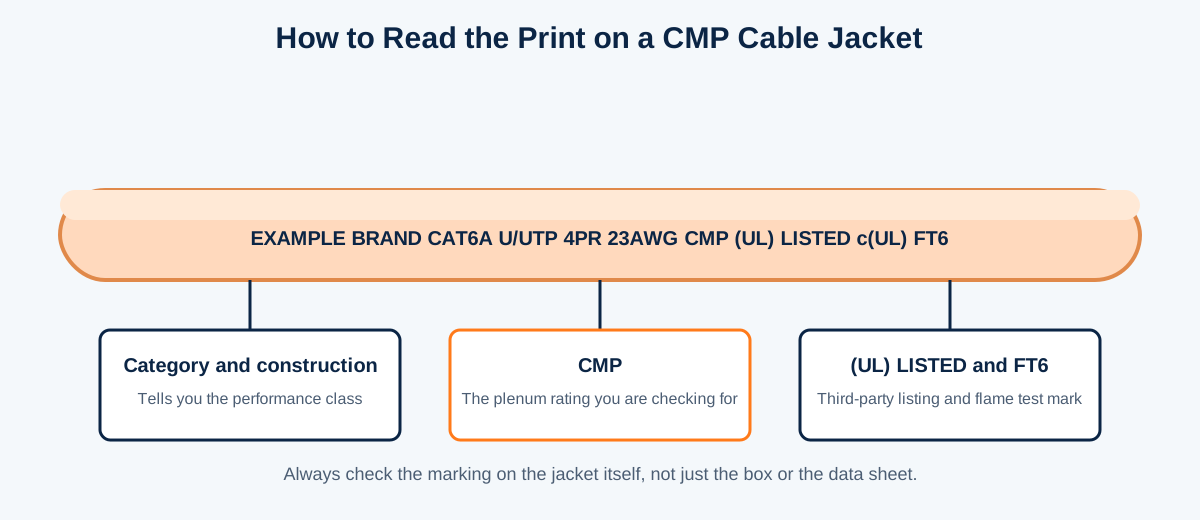
Plenum jackets use low-smoke PVC or FEP (fluorinated ethylene polymer) insulation to cut both flame spread and smoke production. CMP is tested to UL 910, where flame travel is limited to about five feet, or to NFPA 262, the equivalent method referenced in NFPA 90A. Plenum cable must also be marked on the jacket itself, so an inspector can confirm the rating at a glance. This engineering overview of plenum cabling rules covers the substitution and marking requirements in more detail.
CMP vs CMR vs CM: What Is the Difference?
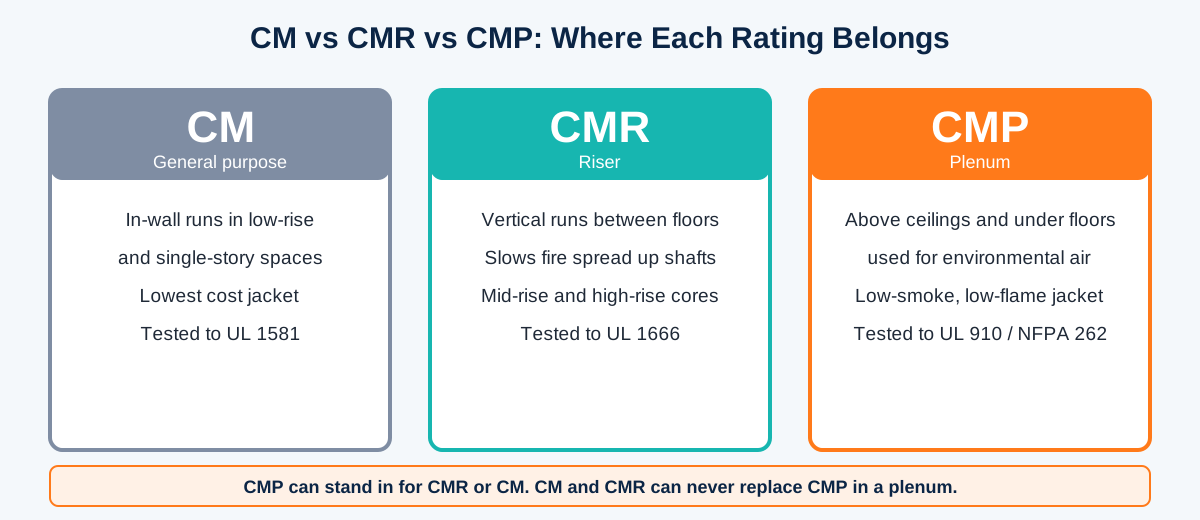
| Rating | Name | Typical location | Fire test | Relative cost |
|---|---|---|---|---|
| CM | General purpose | In-wall, low-rise, single-story spaces | UL 1581 / CSA FT1 | Lowest |
| CMR | Riser | Vertical shafts between floors | UL 1666 / CSA FT4 | Medium |
| CMP | Plenum | Above ceilings, under floors, air-handling spaces | UL 910 / CSA FT6 (NFPA 262) | Highest |
The substitution rule
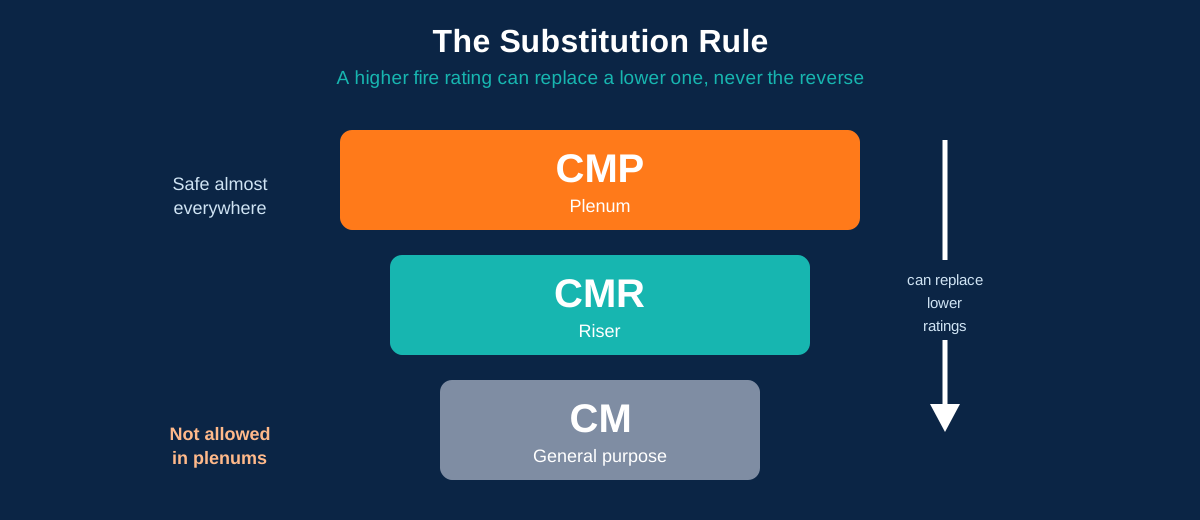
A higher rating may stand in for a lower one, but never the reverse. That means CMP can be used where CMR or CM is required, while CM and CMR are not acceptable in a plenum. Some designers specify CMP for an entire floor for exactly this reason: one cable type removes any chance of a wrong-rating mix-up.
Why CMR is not a shortcut
Riser cable is built to stop fire climbing between floors, not to limit smoke in an air stream. Using it above a return-air ceiling is a classic reason for failed inspections. For a deeper look at the ratings, see this CM vs CMR vs CMP breakdown.
Plenum-Rated Cable (CMP) for NYC Office Buildings: What Applies
National standards set the baseline, and New York layers its own rules on top. Projects in the city must follow the NYC Electrical Code and Fire Code in addition to national references such as the NEC and TIA-568. Use the points below as a planning guide, then confirm specifics with the NYC Department of Buildings, the FDNY and the building’s management. This is general information, not legal advice.
Confirm whether the ceiling is a plenum
The definitions come from the NEC and the International Mechanical Code, available from the International Code Council. In many Manhattan office floors the above-ceiling space doubles as return air, so plenum cable is required. Ask the building engineer for the mechanical drawings instead of assuming. When in doubt, specify CMP.
Where CMP is typically required in an office
- Above dropped ceilings that carry return air.
- Under raised floors used for air distribution.
- Open ceilings where the exposed space serves as an air path.
- Telecom and IT rooms whose ceiling or floor cavities carry air.
For any plenum-rated cable (CMP) for NYC office buildings project, record these locations on your floor plan before ordering, because pulling cable twice is the most expensive mistake on the job.
Riser cable still has a place
Vertical runs through core shafts between floors call for riser cable (CMR) at minimum. A plenum-rated cable can be used there too, and some contractors choose it for consistency. Penetrations between floors also need proper firestopping.
Fire alarm cable is a separate category
Fire alarm wiring in New York follows its own performance rules and approved products, including Local Law 5 and Rule 1 RCNY 4000-06. Do not substitute data cable for it, and let the licensed fire alarm contractor handle that scope.
Building rules often go beyond the code
Even where no permit is needed for a low-voltage task, landlords commonly require insurance certificates, approved-vendor status, riser access with an escort and after-hours work windows. Build these approvals into your schedule, because many New York projects slip on access rather than on cable.
Plenum Markings for Every Cable Type
Each cable family has its own plenum designation. Check the marking that matches the system you are installing.
| System | Plenum marking | Riser marking | Examples |
|---|---|---|---|
| Data and voice (copper) | CMP | CMR | Cat6, Cat6A |
| Optical fiber | OFNP / OFCP | OFNR / OFCR | OM4, OS2 fiber |
| Power-limited circuits | CL2P / CL3P | CL2R / CL3R | Security, access control, audio |
| Fire alarm | FPLP | FPLR | Life-safety circuits |
| Coaxial / CATV | CATVP | CATVR | Video, broadband |
The suffix tells the story: a trailing P means plenum, R means riser, and no letter means general purpose. PoE power over copper adds its own rules, so confirm the cable category and bundle size for high-wattage devices.
Cost, Flexibility and Installation
Why CMP costs more
Plenum jackets use restricted flame-retardant materials, so plenum and riser versions of the same cable generally cost noticeably more than general-purpose versions. The extra spend is usually small next to labor and the cost of a failed inspection, and industry coverage such as Cabling Installation & Maintenance notes that demand for plenum cable remains strong. Product listings are verified by UL Solutions.
Stiffer cable needs more care
Those same materials make plenum cable stiffer, with larger bend radii. Tight bends can crack or tear the jacket and insulation, so allow generous curves at tray transitions and patch panels. Careful routing also protects low voltage cabling installation performance over the long term.
Support and pathway best practices
- Use dedicated J-hooks, trays or supports instead of tying cable to ceiling grid wires, ducts or pipes.
- Do not overfill pathways, and keep data separated from power.
- Firestop every wall and floor penetration with a listed system.
- Remove abandoned cable that is not tagged for future use, which the NEC no longer allows to stay in plenum spaces.
- Test every run, label both ends and keep as-built records.
Pre-Order Checklist: How to Specify CMP Cable
- Map the pathways. Mark every ceiling cavity, raised floor and shaft on the plan.
- Confirm air use. Ask the building engineer which spaces carry environmental air.
- Pick the rating per pathway. CMP for plenums, CMR for risers, or CMP throughout for simplicity.
- Match the system. Choose CMP, OFNP, CL2P/CL3P, FPLP or CATVP as appropriate.
- Check the jacket print. Verify the rating and listing marks on the cable itself.
- Clear building access. Submit insurance and schedules to management early.
- Plan testing and labels. Budget for certification and documentation.
Common Mistakes to Avoid
- Assuming riser cable is good enough above ceilings. It is not accepted in a plenum.
- Skipping the airflow check. Guessing whether a ceiling is a plenum leads to rework.
- Mixing cable families. A CMP data cable does not make a fire alarm circuit compliant.
- Tight bends and heavy bundles. They damage stiff jackets and block airflow.
- Leaving dead cable behind. Abandoned runs add fire load and can breach code.
- Forgetting building paperwork. Missing insurance or access approvals delay installs.
How to Hire a Cabling Contractor in New York
Look for a team that understands Manhattan buildings, designs and installs low-voltage systems and will coordinate with building management. For plenum-rated cable (CMP) for NYC office buildings, ask for sample test reports, proof of insurance and references from similar office projects.
New Tech Cabling is a low-voltage cabling company in Midtown Manhattan, near 5th Avenue and 34th Street, serving Manhattan, Brooklyn, Upper Manhattan, Jersey City, Hoboken and Union City. Helpful starting points include:
- Low voltage cabling installation
- Low voltage cabling design build
- IT room build out
- Data center build out
- Security systems cabling
- Relocations and project management
You can also read the company’s white paper on cable and wiring, browse its network installations, or see more guides on the blog.
Frequently Asked Questions
What does CMP mean on a cable?
CMP means Communications Multipurpose Cable, Plenum. It is the fire rating for cable approved to run in plenum spaces such as ceilings and floors used for air handling, and it appears printed on the cable jacket.
Is plenum cable required in NYC office buildings?
It is required wherever the cable runs through a space used for environmental air, such as many above-ceiling return-air cavities. Always confirm how each space is used and follow the NYC codes and building rules.
Can I use CMR riser cable above a drop ceiling?
Not if the ceiling cavity is a plenum. CMR is intended for vertical shafts, and only CMP is accepted in air-handling spaces.
Can CMP cable be used instead of CM or CMR?
Yes. A higher fire rating can replace a lower one, so CMP can be installed where CM or CMR is required. The reverse is not allowed.
Is Cat6A available in plenum rating?
Yes. Cat6 and Cat6A are both made in CMP versions. Check the jacket marking, bend radius and bundle limits before installation.
Why is plenum cable more expensive?
Its jacket uses restricted low-smoke, flame-retardant materials, which cost more than standard PVC. The materials also make the cable stiffer, so it needs larger bends.
Does fire alarm cable follow the same rule?
Fire alarm wiring has its own plenum marking (FPLP) and New York-specific approvals, so it is handled separately from data cabling by a licensed contractor.
Need Plenum Cabling Done Right?
For code-conscious, tested and documented plenum-rated cable (CMP) for NYC office buildings, talk to the New Tech Cabling team about your floor, building and timeline.
Recent Comments