
Emergency Network Cabling Repair NYC: What to Do When Your Network Goes Down
A practical guide for New York businesses on diagnosing cable faults, getting a failed link back online quickly, and making sure the same outage does not happen twice.
QUICK ANSWER
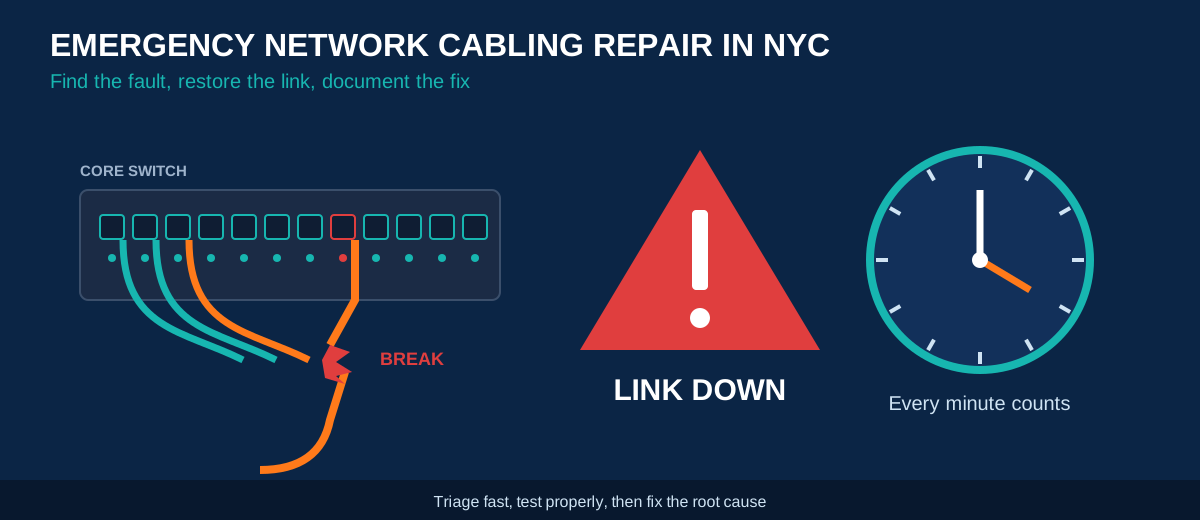
Emergency network cabling repair is the fast diagnosis and repair of failed network cable, connectors, patch panels or pathways that have taken a link or an entire office offline. A technician isolates the failing link, tests it with a cable tester, re-terminates or replaces the damaged section, certifies the result and documents the fix. If swapping a patch cord and port does not restore service, call a cabling professional.
When the network drops in a Manhattan office, every minute is expensive. Phones, cloud applications, security cameras and payment systems all depend on a physical cable somewhere above a ceiling or behind a wall. This guide explains the common causes of failure, a safe first-response checklist, what happens during a professional visit, and how to choose a provider for emergency network cabling repair NYC businesses can rely on.
Key Takeaways
- Most outages start at the physical layer: a damaged cable, a bad termination, a worn connector or a failed port.
- Define the scope first. One desk points to a patch cord or jack, a whole floor points to a switch or backbone link.
- Swap one thing at a time, and stop once the quick checks fail to restore service.
- A proper repair ends with a certified test result and updated labels, not just a blinking link light.
- In New York, building access, insurance and after-hours rules can affect how fast a repair can happen.
In This Guide
- Why cabling outages cost so much
- Common causes of cable failure
- Your first 15 minutes
- How technicians find the fault
- What an emergency repair visit looks like
- NYC-specific challenges
- Preventing the next outage
- Choosing a repair provider
- FAQ
Why Network Cabling Outages Cost So Much
A single failed link can silence a department, and a failed backbone can stop an entire business. Industry surveys on downtime, such as the ITIC figures discussed in this small-business downtime overview, put the cost of an hour offline in the tens of thousands of dollars or more, and describe those numbers as conservative for small firms. Your own cost depends on headcount, billing and how much work runs through the cloud, but the lesson is the same: restore service first, then investigate.
Cabling is also unusual because it hides. Unlike a failed server, a failed run is invisible until a user reports a dead port, so a quick, structured response matters.
Common Causes of Network Cable Failure
Physical damage and wear
- Breaks and kinks: cables crushed by furniture, pinched in ceilings or bent past their bend radius.
- Damaged connectors: cracked plugs, bent pins or worn jacks from repeated plugging.
- Construction and tenant work: other trades cutting, moving or pulling on cable.
Installation and termination problems
- Poor punch-downs: loose or untwisted pairs at a patch panel or jack.
- Wrong wiring order: mixed T568A and T568B pin assignments, or conductors landing on the wrong pins.
- Over-tightened cable ties: compression that degrades signal quality over time.
Component and environment issues
- Failed ports or switches: sometimes the cable is fine and the port is not.
- Excess length or the wrong category: links that exceed 100 meters or use cable that cannot support the application.
- Low-quality or non-standard cable: copper-clad steel conductors can raise resistance and heat in Power over Ethernet use.
Your First 15 Minutes in a Network Outage
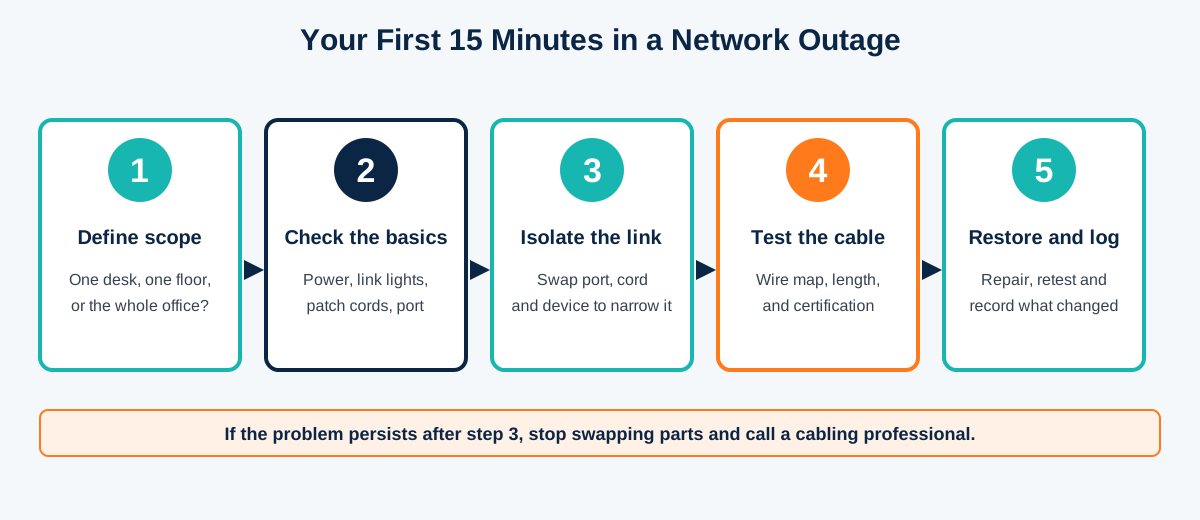
- Define the scope. Is it one device, one desk, one floor or the whole office? Scope tells you whether to suspect a patch cord, a switch or a backbone link.
- Check the basics. Confirm power, look at link lights, and reseat patch cords at both ends.
- Isolate the link. Swap one item at a time: a known-good patch cord, a different switch port, a different device. Change only one variable per test.
- Test the cable. If the fault follows the permanent cable, it needs a cable tester, not more guessing.
- Restore and log. Once service is back, record what failed and what changed.
Do not pull on cables above ceilings, open ceiling tiles near sprinklers or work in electrical rooms unless you are authorized. If the quick checks do not restore service, stop swapping parts and call a professional, because repeated handling can turn one fault into several.
How Technicians Find the Fault
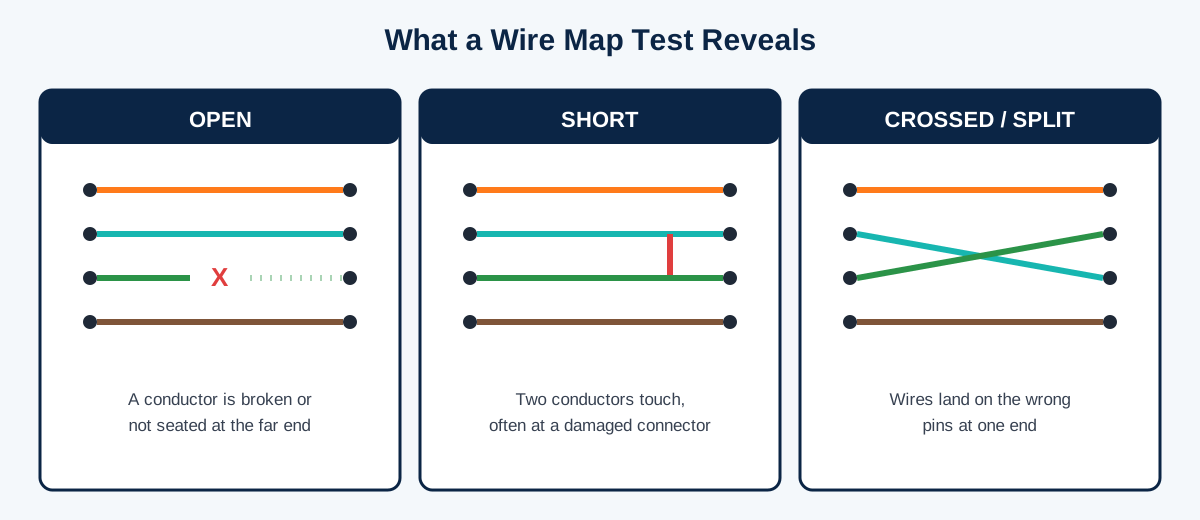
Professionals use certification-grade testers instead of trial and error. A wire map test confirms every conductor reaches the right pin, and further tests check length, loss and crosstalk. Guidance from Cabling Installation & Maintenance links test results to likely causes.
| Test result | Typical meaning | Usual fix |
|---|---|---|
| Open | Broken conductor, bad punch-down or damaged connector | Re-terminate or replace the connector or run |
| Short | Conductors touching at a damaged connector or cable | Replace the damaged section or connector |
| Crossed or split pair | Conductors on wrong pins or mixed wiring standards | Re-terminate to a single standard |
| Length too short | Possible break in the cable | Locate and repair the break |
| High crosstalk or return loss | Untwisted pairs, tight bends, crushed cable or bad patch cords | Re-terminate, re-route or replace patch cords |
What an Emergency Repair Visit Looks Like
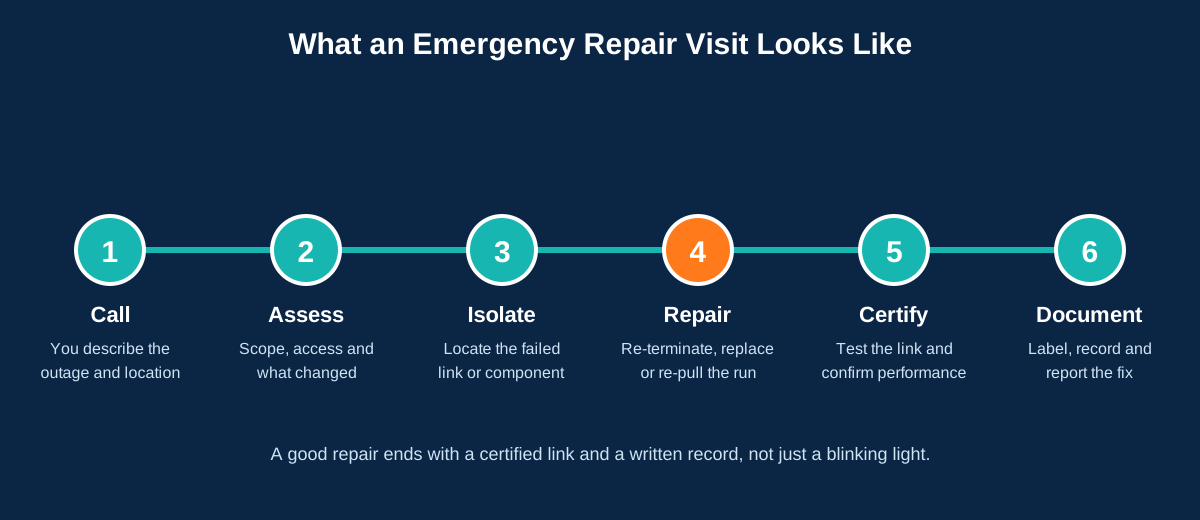
For emergency network cabling repair NYC offices need, a good visit follows a clear sequence: you describe the outage and location, the technician assesses scope and access, isolates the failing link or component, repairs it, certifies the result and documents the change. Expect questions about what changed recently, such as construction, moves or new equipment, because those clues shorten the search.
Repair or re-pull?
A damaged connector or bad termination can often be re-terminated in minutes. A broken or crushed run inside a wall or ceiling may need a new cable, and the right cable rating matters. In many New York office ceilings that means plenum-rated cable, so check your jacket marking before any replacement.
What you should receive afterwards
- Test results showing the repaired link passes.
- Updated labels on both ends of the cable and the patch panel port.
- A short report of the cause, the fix and any risks nearby.
NYC-Specific Challenges for Emergency Repairs
Repairs in New York come with local constraints that can slow a fix if you are not prepared. Many buildings require insurance certificates, approved-vendor status, riser or telecom room access with an escort, and limited work hours. Share these requirements with your provider up front, and keep contact details for building management and the engineer handy.
Codes also matter. Projects must follow the NYC Electrical Code and Fire Code alongside national references, and fire alarm cabling has its own rules and approved products. Confirm details with the NYC Department of Buildings, the FDNY and your landlord. This guide is general information, not legal advice.
Preventing the Next Outage
- Document your cabling: keep labeled drawings, port maps and test reports so any technician can trace a link in minutes.
- Keep pathways tidy: use proper cable management, respect bend radius and avoid overfilled trays.
- Standardize terminations: use one wiring standard across the office.
- Use quality cable and components: avoid non-standard conductors, especially for Power over Ethernet.
- Test after moves and construction: a quick certification after any work catches problems before users do.
- Plan for growth: a structured design with spare capacity means fewer emergency changes.
A planned maintenance routine is the best defense against the next call for emergency network cabling repair NYC offices dread. Standards bodies such as the Telecommunications Industry Association publish the cabling and labeling references that good documentation follows, and the National Electrical Code from NFPA governs cable ratings. For ongoing support, moves, adds and changes help keep the physical network in good order, and a project management approach keeps larger changes coordinated.
How to Choose an Emergency Cabling Provider in NYC
Choose before you need one. A provider who already knows your building, riser access and cabling layout will always respond faster than one starting from scratch. Ask about:
- Availability and response expectations, including after-hours options.
- Certification-grade test equipment and sample test reports.
- Proof of insurance and experience with Manhattan building rules.
- Ability to handle voice, data, security and fiber, not just one type.
- Clear documentation after every visit.
New Tech Cabling is a low-voltage cabling company in Midtown Manhattan, near 5th Avenue and 34th Street, serving Manhattan, Brooklyn, Upper Manhattan, Jersey City, Hoboken and Union City, with office hours Monday to Friday, 7:00 am to 6:00 pm. For emergency network cabling repair NYC clients can call to confirm availability for their situation. Related services include:
- Low voltage cabling installation
- Network installations
- Physical network support, moves, adds and changes
- IT room build out
- Security systems cabling
- Relocations
You can also read the company’s white paper on cable and wiring or browse the blog for more guides.
Frequently Asked Questions
What is emergency network cabling repair?
It is the fast diagnosis and repair of failed network cable, connectors, patch panels or pathways that have taken a link or whole office offline. It usually includes testing, repair or replacement, certification and documentation.
How do I know if the cable or the switch is the problem?
Swap one variable at a time. Try a known-good patch cord and a different switch port. If the fault stays with the permanent cable run, the cable or its terminations need testing.
Can a damaged network cable be repaired?
Often yes. A damaged connector or bad termination can be re-terminated. A broken or crushed run inside a wall or ceiling usually needs to be replaced with new cable of the correct rating.
How long does an emergency cabling repair take?
A connector or patch panel fix can take under an hour once the technician is on site, while a new run takes longer. Building access and after-hours rules in New York often affect the schedule.
What tests prove the repair worked?
A wire map test confirms every conductor is connected correctly, and certification tests check length, loss and crosstalk. Ask for the test report as proof.
Do I need plenum-rated cable for a replacement run?
If the run passes through a space used for environmental air, such as many above-ceiling return-air cavities, the cable must be plenum-rated. Confirm the space type and check the jacket marking.
How can I prevent cabling outages?
Keep labeled documentation, use quality cable and consistent terminations, manage pathways properly and test after construction or moves.
Network Down? Get It Fixed Properly
For reliable emergency network cabling repair NYC businesses can trust, contact the New Tech Cabling team to discuss your outage, building and timeline.
Recent Comments