
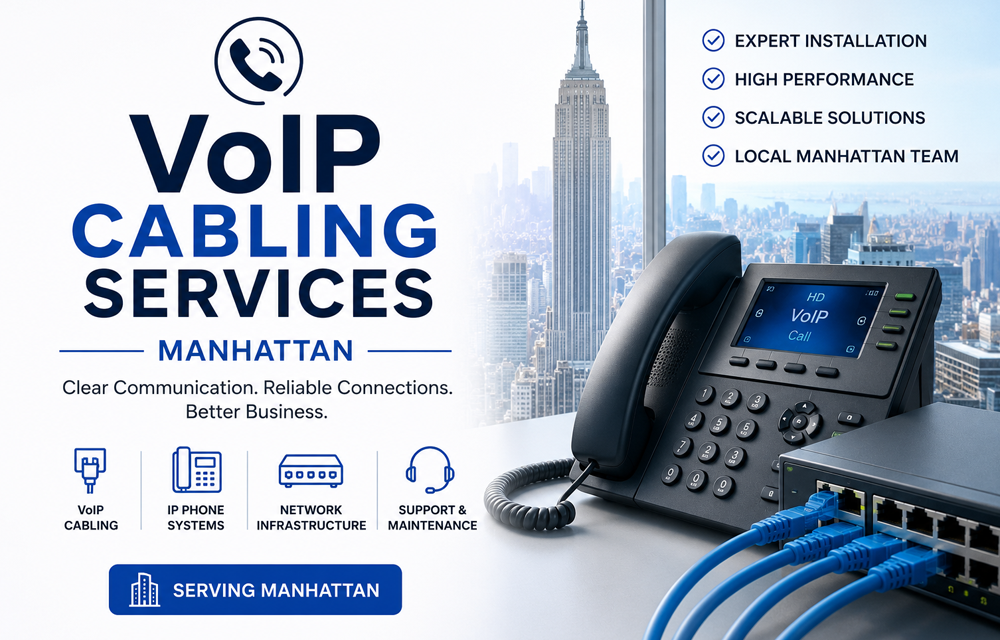
VoIP Cabling Services Manhattan: What Your Office Actually Needs
If your office phones are choppy, dropping calls, or just feel a step behind, the problem often isn’t the VoIP provider — it’s what’s running behind the walls. VoIP cabling services in Manhattan cover the physical network infrastructure your phone system actually depends on, and when that part gets overlooked, no amount of software tweaking fixes it. Before you blame your provider, it’s worth understanding what proper VoIP cabling looks like and why it matters more than most people expect.
Here’s a clear breakdown of what VoIP cabling services in Manhattan involve, how they differ from traditional phone wiring, and what to look for before hiring anyone for the job.
What Are VoIP Cabling Services?
VoIP cabling services involve installing and configuring the network cabling that carries voice traffic over your data network instead of a separate phone line. Since VoIP phones connect through standard ethernet cable rather than old-style copper phone lines, the quality of your VoIP calls depends directly on how well that underlying network cabling was installed.
A proper VoIP cabling setup in Manhattan typically covers:
- Structured cabling sized for combined voice and data traffic
- Power over Ethernet (PoE) planning for VoIP handsets
- Network switch configuration that prioritizes voice traffic
- Cable testing to confirm call quality won’t suffer from interference
- Proper labeling so phone lines can be traced and troubleshot easily
Because voice traffic is sensitive to delay and interruption in a way regular data traffic isn’t, even small cabling mistakes tend to show up as dropped calls or garbled audio long before they’d cause a noticeable problem elsewhere on the network.
VoIP Cabling vs. Traditional Phone Wiring: What’s the Difference?
Traditional phone systems ran on their own dedicated copper lines, completely separate from the data network. VoIP collapses that distinction — voice and data now travel over the same cabling, which changes both what gets installed and how it needs to be planned.
| Factor | Traditional Phone Wiring | VoIP Cabling |
|---|---|---|
| Cable type | Dedicated copper phone line | Standard ethernet (Cat6/Cat6A) |
| Network dependency | Independent of data network | Shares the same network infrastructure |
| Power delivery | Powered separately by phone company | Usually Power over Ethernet (PoE) |
| Sensitivity to cabling quality | Lower | Higher — poor cabling directly affects call quality |
| Scalability | Requires new lines per phone | Scales with existing network capacity |
Since VoIP shares infrastructure with your regular network, cabling that would technically “work” for basic internet browsing might still cause noticeable call quality issues. That’s why VoIP cabling services in Manhattan usually involve a bit more planning than a standard data cabling job, especially around network switch configuration and PoE capacity.
DOs for VoIP Cabling Services Manhattan
- Do plan for Power over Ethernet from the start. Most VoIP phones draw power through the cable itself, so your switches need enough PoE capacity for every handset.
- Do prioritize voice traffic on your network. Quality of Service (QoS) settings on your switches keep voice calls clear even when the network is busy with other traffic.
- Do test cable runs specifically for VoIP performance. A cable that handles web browsing fine can still introduce enough latency to make calls choppy.
- Do plan capacity for growth. Adding phone lines later should mean plugging into existing capacity, not tearing into walls again.
- Do label every phone line clearly. When a call quality issue comes up, clear labeling turns a long troubleshooting session into a quick fix.
DON’Ts for VoIP Cabling Services Manhattan
- Don’t assume your existing cabling is automatically good enough. Older cabling that worked fine for basic data use can struggle under VoIP’s timing requirements.
- Don’t skip PoE capacity planning. Running out of PoE budget mid-installation means phones that won’t power on properly.
- Don’t ignore network congestion. Without proper QoS settings, a busy network can make voice calls drop or lag, even on good cabling.
- Don’t mix unrelated cable runs without labeling. Untangling which cable belongs to which phone later is a headache that’s easy to avoid upfront.
- Don’t hire based on the lowest quote alone. A cheaper install that skips testing or PoE planning tends to cost more once call quality problems start.
How to Choose the Right VoIP Cabling Services in Manhattan
Not every contractor who installs standard data cabling has real experience tuning a network specifically for voice traffic. Before hiring, ask whether they understand PoE budgeting, QoS configuration, and how to test for the kind of latency that affects call quality specifically — not just general network throughput.
It also helps to think about how VoIP cabling connects to the rest of your network. If you’re setting up or upgrading your broader office network, our guide on ethernet cabling installation in NYC covers the fundamentals your VoIP system will run on top of. And if your office also needs security, access control, or other systems handled, our piece on low voltage cabling contractor Manhattan walks through the bigger picture of hiring for that kind of combined project.
Similarly, if your office is deciding between copper and fiber for the backbone your VoIP traffic will ride on, Cat6 vs Fiber: What’s Right for Your NYC Office? is worth a look before finalizing your setup. And for the full picture on hiring a contractor for a larger cabling project, our guide on choosing a network cabling contractor in NYC is a good place to start.
A Quick Checklist Before You Start
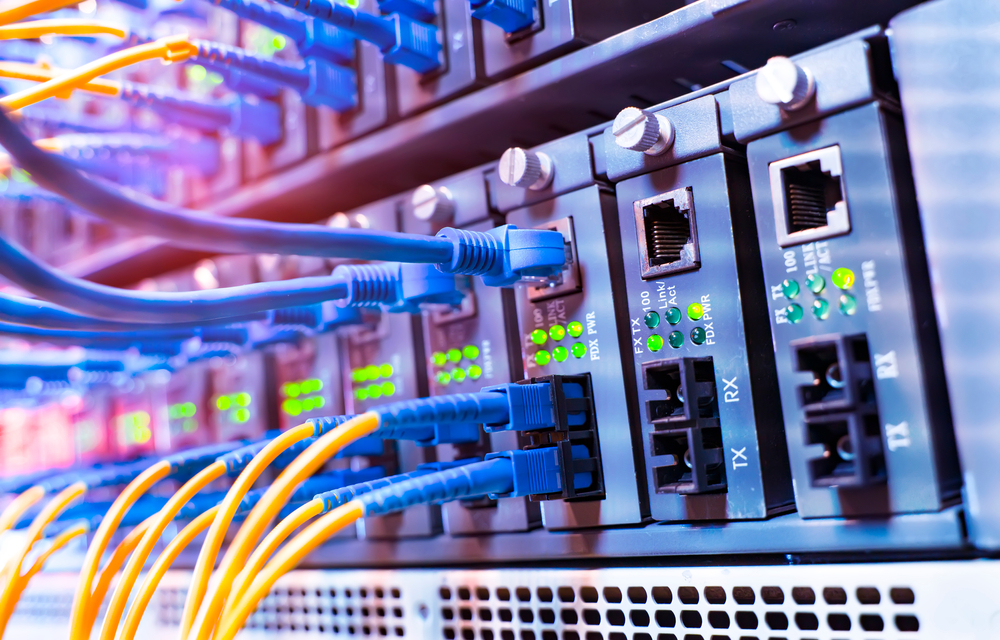
- Have you confirmed your switches have enough PoE capacity?
- Are QoS settings configured to prioritize voice traffic?
- Will every cable run be tested specifically for VoIP performance?
- Is there room to add more phone lines without new cabling later?
- Are all phone lines labeled clearly for future troubleshooting?
- Does the contractor have actual VoIP-specific cabling experience?
Frequently Asked Questions
Can I use my existing ethernet cabling for VoIP?
Sometimes, if it tests well and your switches have enough PoE capacity. However, older or poorly installed cabling can introduce latency that shows up as call quality issues, so it’s worth testing before assuming it’ll work.
Do VoIP phones need their own dedicated cabling?
Not usually. VoIP phones typically share the same ethernet infrastructure as the rest of your network, which is part of why proper planning and QoS configuration matter so much.
What is Power over Ethernet, and why does it matter for VoIP?
PoE lets network cable deliver both data and electrical power to a device, meaning your VoIP phones don’t need a separate power outlet. Insufficient PoE capacity is one of the most common reasons VoIP installations run into trouble.
Why do VoIP calls sometimes sound choppy even with good internet?
Choppy calls are often caused by network congestion, poor QoS configuration, or cabling issues inside the office itself — not necessarily your internet connection. A proper VoIP cabling setup addresses exactly this.
How much do VoIP cabling services cost in Manhattan?
It depends on office size, number of phone lines, and whether new cabling or network upgrades are needed. A site assessment is the most reliable way to get an accurate estimate for your space.
Getting VoIP Cabling Services in Manhattan Right the First Time
VoIP has made phone systems more flexible and often cheaper to run, but that flexibility only holds up if the cabling underneath is planned properly. Skipping the details — PoE capacity, QoS, proper testing — tends to show up later as dropped calls and frustrated staff, right when you least want it. NewTech Cabling handles VoIP cabling services in Manhattan the way it should be done from the start, so your phone system actually performs the way it’s supposed to.
If you’re setting up a new office, switching providers, or dealing with ongoing call quality issues, it’s worth getting the cabling assessed before assuming the problem is somewhere else.
Dealing with dropped calls or planning a new VoIP setup in Manhattan?
Contact NewTech Cabling Today →
📞 (212) 537-5965 | 📧 info@newtechcabling.com |
🌐 newtechcabling.com
Recent Comments