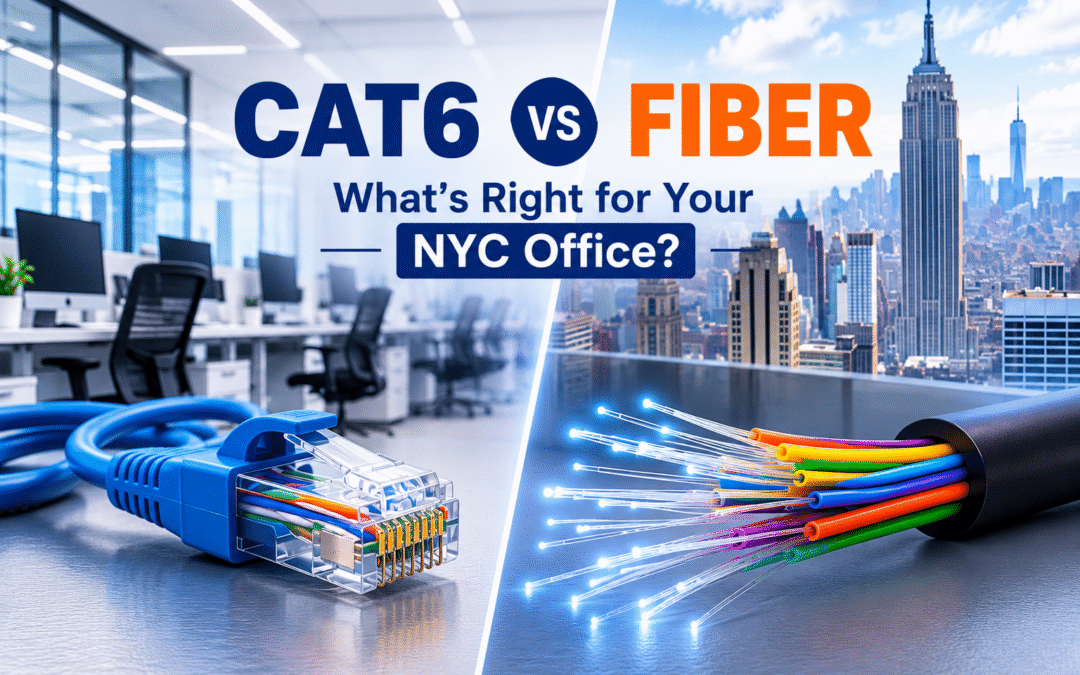
Cat6 vs Fiber
If you’re setting up or upgrading a network and stuck comparing Cat6 vs fiber, you’re not alone — it’s one of the most common questions we get from NYC offices before a cabling project starts. Both are solid choices, but they solve different problems, and picking the wrong one can mean paying for bandwidth you don’t need or running into a wall you didn’t see coming a year from now.
Here’s a plain-language breakdown of Cat6 vs fiber, so you can walk into your next cabling conversation actually knowing what you’re asking for.
What Is Cat6 Cabling?
Cat6 is a type of copper twisted-pair cable, and it’s the standard workhorse for most office networks today. It handles data speeds up to 10 Gbps over shorter distances, costs less to install than fiber, and works with equipment most IT teams already have on hand. For a typical office running email, file sharing, video calls, and everyday internet use, Cat6 usually gets the job done without any fuss.
Cat6A, a step up from standard Cat6, pushes that 10 Gbps performance out to longer cable runs and holds up better against interference — worth considering if your office has a lot of electrical equipment nearby or you want more headroom before the next upgrade.
What Is Fiber Optic Cabling?
Fiber optic cable sends data as pulses of light instead of electrical signals, which is why it can move enormous amounts of data over much longer distances without losing quality. It doesn’t pick up electrical interference the way copper can, and it’s the only real option once you’re running cable between floors, between buildings, or across distances longer than about 100 meters.
Fiber also scales further into the future. If your business plans to grow into heavier data use — bigger video files, more remote backup, more connected devices — fiber has more room to grow into than copper does.
Cat6 vs Fiber: Key Differences
| Factor | Cat6 / Cat6A | Fiber Optic |
|---|---|---|
| Signal type | Electrical | Light |
| Max distance (full speed) | ~100 meters | Several kilometers (single-mode) |
| Speed | Up to 10 Gbps | 10 Gbps and well beyond |
| Interference resistance | Moderate | Immune to electrical interference |
| Installation cost | Lower | Higher |
| Best for | Workstations, general office use | Backbone runs, inter-floor, inter-building links |
Cat6 vs Fiber: Which One Fits Your NYC Office?
Most NYC offices don’t actually have to pick one over the other — they end up using both, just in different places. Cat6 or Cat6A handles the horizontal runs to individual desks and workstations, while fiber carries the heavier backbone traffic between floors, wiring closets, or separate office locations.
A few things worth thinking through before deciding:
How far does the cable need to run? Copper starts losing performance past 100 meters. If you’re connecting across floors or a larger footprint, fiber is the safer bet.
How much interference is around? Older NYC buildings often have a mess of electrical wiring, elevators, and HVAC equipment running through the same spaces as your network cabling. Fiber shrugs off that interference; copper can be more sensitive to it.
What’s your growth plan? If you’re expecting to add more staff, more devices, or heavier data use in the next few years, fiber gives you more runway before you have to touch the infrastructure again.
What’s your budget right now? Cat6 is cheaper to install today. Fiber costs more up front but can save money later by avoiding a second round of cabling work.
If any of this is speaking to a bigger project — a full office setup, a move, or a build-out — it’s worth getting a proper look at your space rather than guessing. A network cabling contractor in NYC can walk your building and tell you exactly where copper is enough and where fiber earns its keep.
Where This Comes Up Most Often
A few situations tend to force the Cat6 vs fiber decision sooner rather than later:
Office relocations. Moving to a new space is the easiest time to get your cabling right, before desks and furniture are in the way. If you’re planning a move, it’s worth reading up on office relocation cabling before the date is locked in.
Conference rooms and shared spaces. Video conferencing, screen sharing, and multiple connected devices in one room can push a Cat6 setup harder than people expect. Some conference room build-outs are better served with fiber backbone feeding into the room.
Growing or messy networks. If your current cabling has grown in patches over the years, a real cable management plan often reveals where copper is maxed out and where fiber should be doing the heavy lifting instead.
A Quick Checklist Before You Decide
- Do you know how far your longest cable run needs to reach?
- Is there heavy electrical or mechanical equipment near your cable paths?
- Are you planning to grow headcount or data use in the next few years?
- Do you need to connect across floors or between buildings?
- Does your budget allow for a mixed Cat6 and fiber setup?
- Has anyone actually tested your current cabling’s performance?
Frequently Asked Questions
Is fiber always faster than Cat6?
Not necessarily at short distances — both can hit 10 Gbps. Fiber pulls ahead once distances get longer or speeds need to go well beyond what copper can reliably carry.
Can I mix Cat6 and fiber in the same office?
Yes, and most offices already do. Fiber usually handles the backbone between floors or wiring closets, while Cat6 covers the runs out to individual desks.
Is Cat6A worth the extra cost over standard Cat6?
If you need longer cable runs at full speed or you’re dealing with interference, Cat6A is usually worth it. For a small, straightforward office setup, standard Cat6 is often enough.
Does fiber cost a lot more to install?
Fiber generally costs more upfront than Cat6, mainly due to the cable and termination equipment. For long runs or backbone connections, it often pays for itself by avoiding a second cabling project later.
How do I know which one my office actually needs?
The honest answer is a site visit. Building layout, distances, existing infrastructure, and growth plans all factor in, and a contractor who’s walked hundreds of NYC offices can usually spot the right setup in one visit.
Getting the Cat6 vs Fiber Decision Right the First Time
There’s no universal right answer between Cat6 and fiber — the right setup depends on your building, your distances, and where your business is headed. What matters is making that call with someone who understands both, instead of defaulting to whatever’s easiest to install.
If you’re planning a new cabling project, an office move, or an upgrade anywhere in New York City, it’s worth getting a real assessment before spending on either option.
Not sure whether your office needs Cat6, fiber, or both?
Contact NewTech Cabling Today →
📞 (212) 537-5965 | 📧 info@newtechcabling.com |
🌐 newtechcabling.com
Recent Comments