

Telecommunications Cabling NYC: Complete Business Solutions
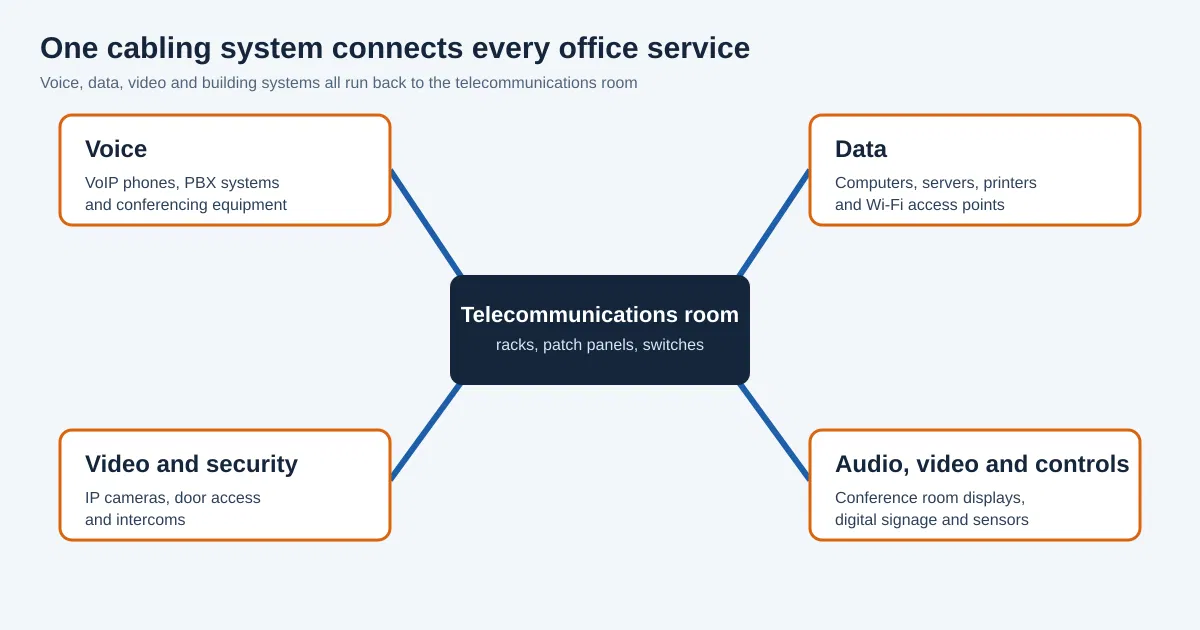
Every phone call, video meeting, file transfer, security camera and cloud app in a New York office depends on the same thing: the telecommunications cabling behind the walls. When it is designed and installed well, nobody notices it. When it is not, the whole business feels it through dropped calls, slow connections, tangled closets and long outages. New Tech Cabling, based in Midtown Manhattan, designs, installs, tests and documents telecommunications cabling for New York businesses, covering voice, data, security and audio/video networks.
This guide explains what telecommunications cabling is, what it carries, how it is laid out from the street to the desk, which cable types and ratings apply, what a telecom room should contain and what affects the cost. You can also browse our full list of network cabling services.
In this guide
- What telecommunications cabling is
- Why professional telecom cabling matters
- What runs on telecommunications cabling
- From the street to the desk
- Cable types and jacket ratings
- The telecommunications room
- Voice, VoIP and phone system cabling
- Telecom cabling challenges in NYC buildings
- Our installation process
- Testing, labeling and documentation
- Standards and codes
- What affects the cost
- Signs your office needs a telecom cabling upgrade
- Common mistakes to avoid
- How to choose a telecom cabling contractor in NYC
- Service areas
- Frequently asked questions
What Is Telecommunications Cabling?
Telecommunications cabling is the permanent system of cables, jacks, panels, racks and pathways that carries voice, data and other signals through a building. In a commercial setting it is usually installed as structured cabling, which means one organized, standards-based system that connects every desk, meeting room and device to a central telecommunications room, and connects that room to the outside world through the carrier service that enters the building.
The term covers more than the cable itself. It includes the pathways that hold the cable, the connection points at each end, the equipment rooms where cables end, the labeling that identifies every run and the records that describe the whole system. Because all of this sits inside walls, ceilings and risers, it is the hardest part of a business network to change later, and the part that benefits most from careful planning.
Why Professional Telecommunications Cabling Matters
- Reliable calls and connections: Properly terminated, tested cable avoids the weak links that cause echo, dropouts and random disconnects, so phones, video calls and cloud apps work the same on a busy afternoon as on a quiet morning.
- One system for many services: A planned cabling system can carry phones, computers, Wi-Fi, cameras and AV equipment together, which costs less than adding a separate system for each service later.
- Easier growth and changes: Spare ports, labeled cables and an organized telecom room mean adding staff, moving desks or adding a floor is a short job instead of a rebuild.
- Faster troubleshooting: Labels and records let a technician trace a connection in seconds, which shortens outages and lowers support bills.
- Safer, cleaner workspace: Cable that is routed, supported and rated for its location avoids trip hazards and fire-code problems, and the office looks professional to clients and visitors.
- Protection of your investment: Quality cable and a sound design can support several generations of equipment, so you are not re-cabling every time technology changes.
What Runs on Telecommunications Cabling
- Voice and VoIP phones: Office phone systems, desk phones and conferencing equipment. Modern phones usually share the same cabling as computers, and many are powered through the cable, so stable cabling means clear calls.
- Data networks: Ethernet connections for computers, servers and printers. This carries email, file sharing, cloud software and internet access, and its quality sets the speed of everything else.
- Wi-Fi access points: Wireless coverage depends on a wired link behind each access point. Each one needs its own cable back to a switch, often with Power over Ethernet.
- Security and surveillance: IP cameras, alarm systems and recording equipment send their traffic and often draw their power over the same cabling. See our security systems cabling.
- Access control and intercoms: Card readers, door controllers and intercoms need a constant connection to work, and their cable runs are best planned with the doors and frames.
- Audio and video systems: Conference room displays, microphones, speakers and digital signage need dedicated runs, ideally hidden. See our conference room design build out.
- Backbone links: Fiber or copper links between telecom rooms, floors and server rooms carry the combined traffic of the whole building.
From the Street to the Desk: How Telecommunications Cabling Is Laid Out
Structured cabling standards describe a commercial building’s telecommunications cabling as a set of standard parts. Knowing them makes it much easier to read a quote, plan a project or find the source of a problem.
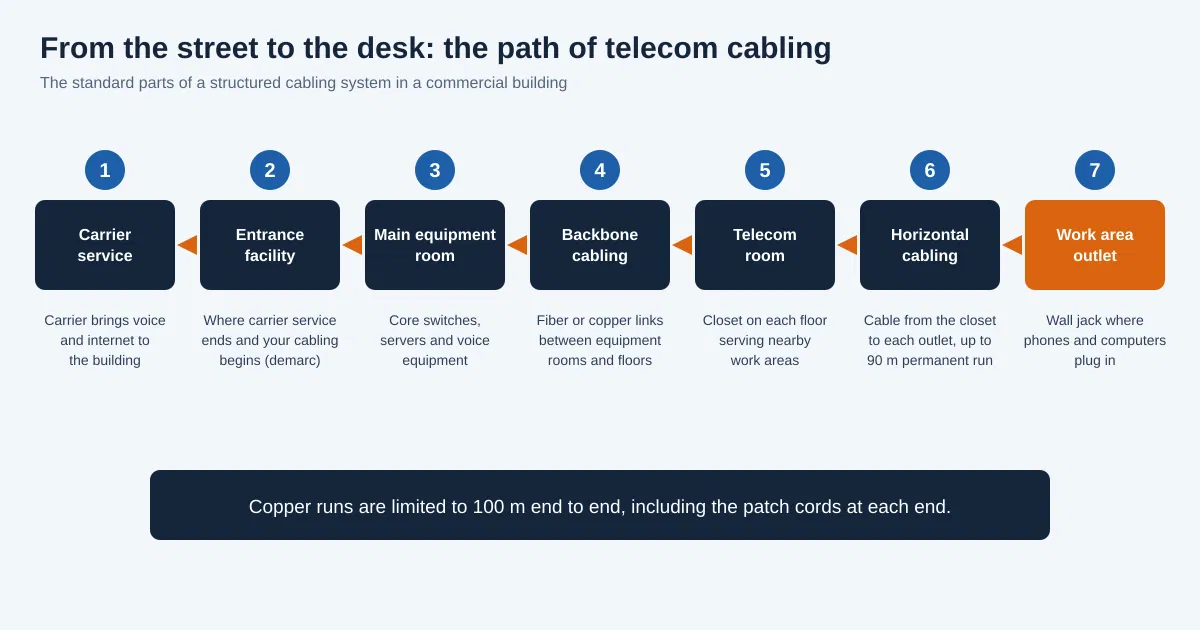
- Carrier service: Voice and internet providers bring their service to the building by fiber or copper. Which carriers reach a given building varies, so ask early which providers are available and how long installation takes.
- Entrance facility and demarcation point: This is where carrier cabling enters the building and ends at the demarc, the point where the carrier’s responsibility stops and yours begins. If your equipment is far from the demarc, a demarc extension carries the service to your telecom room.
- Main equipment room: This room holds the core equipment, such as core switches, servers and the voice system. Its size, power and cooling decide how reliable the rest of the network can be.
- Backbone cabling: Backbone links connect the main equipment room to the telecom rooms on other floors, often by fiber running up the building riser. Our guide to network installations covers how this fits into a larger project.
- Telecommunications room: A closet or small room on each floor where horizontal cables end on patch panels and connect to switches that serve the nearby work areas.
- Horizontal cabling: Cable that runs from the telecom room to each outlet on the floor. The permanent run is limited to 90 meters, and with patch cords the whole channel is limited to 100 meters.
- Work area outlet: The wall jack where a phone, computer or other device plugs in, usually with a short patch cord.
Telecommunications Cable Types and Jacket Ratings
Two choices shape every telecom cabling project: the cable type, which sets speed and distance, and the jacket rating, which sets where the cable may be installed. Here is a simple comparison of the cable types:
| Cable | Typical speed and distance | Best for |
|---|---|---|
| Cat5e | 1 Gbps up to 100 m | Existing installs; usually not recommended for new commercial projects |
| Cat6 | 1 Gbps up to 100 m; 10 Gbps over shorter runs (about 55 m) | Most small and mid-sized offices, VoIP phones and access points |
| Cat6A | 10 Gbps up to 100 m | Heavy data use, many PoE devices and future-proofing |
| Fiber optic | Very high bandwidth over long distances | Backbone links between floors, telecom rooms and buildings |
Jacket ratings matter just as much. Communications cable is rated for the space it runs through, mainly to limit how flame and smoke could spread in a fire.
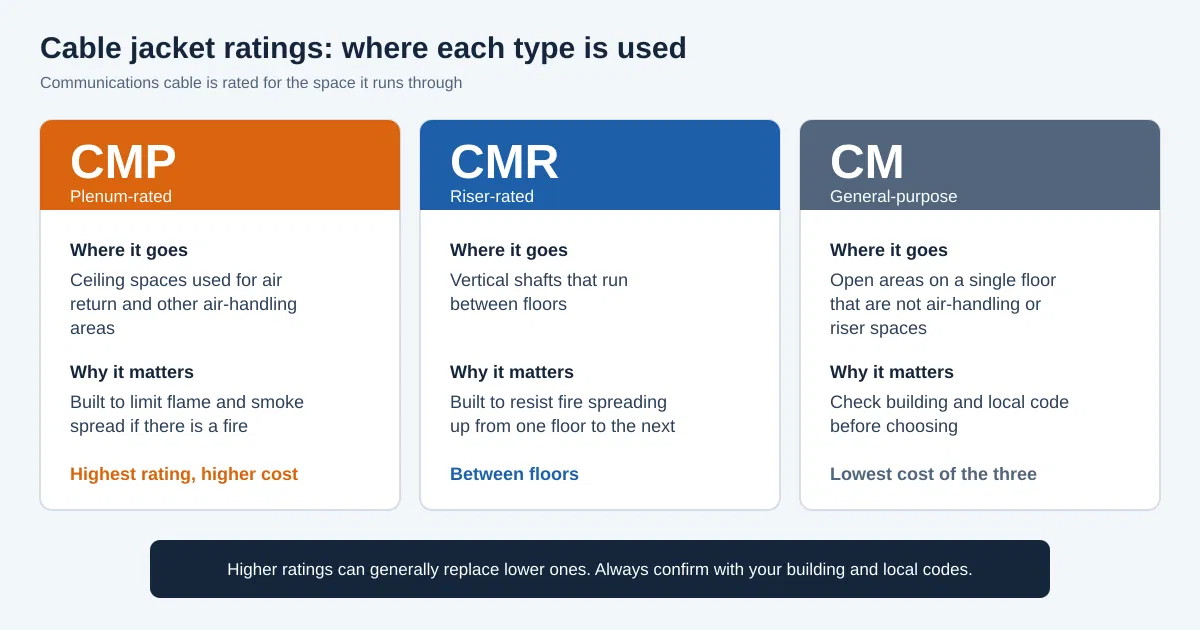
- Plenum-rated (CMP): Required in most ceiling spaces used for air return and other air-handling areas. It costs more, but it is built to limit flame and smoke spread.
- Riser-rated (CMR): Used in vertical shafts between floors, where it must resist fire spreading from one floor to the next.
- General-purpose (CM): Used in open areas that are not air-handling or riser spaces. It is the lowest-cost option, and local code and building rules still apply.
- Fiber ratings: Fiber cable has its own plenum, riser and general ratings, so the same planning applies to the backbone.
- Indoor, outdoor and indoor/outdoor cable: Cable between buildings or through wet locations needs outdoor or indoor/outdoor construction, which is built to resist moisture and sunlight.
For a deeper technical reference, download our white paper on cable and wiring types.
The Telecommunications Room: Where Every Cable Ends
The telecom room is the heart of the system. Every horizontal cable on the floor ends here, and every service that leaves the floor starts here. A well-built room is tidy, cool, powered and secure, which makes the whole network easier to run.
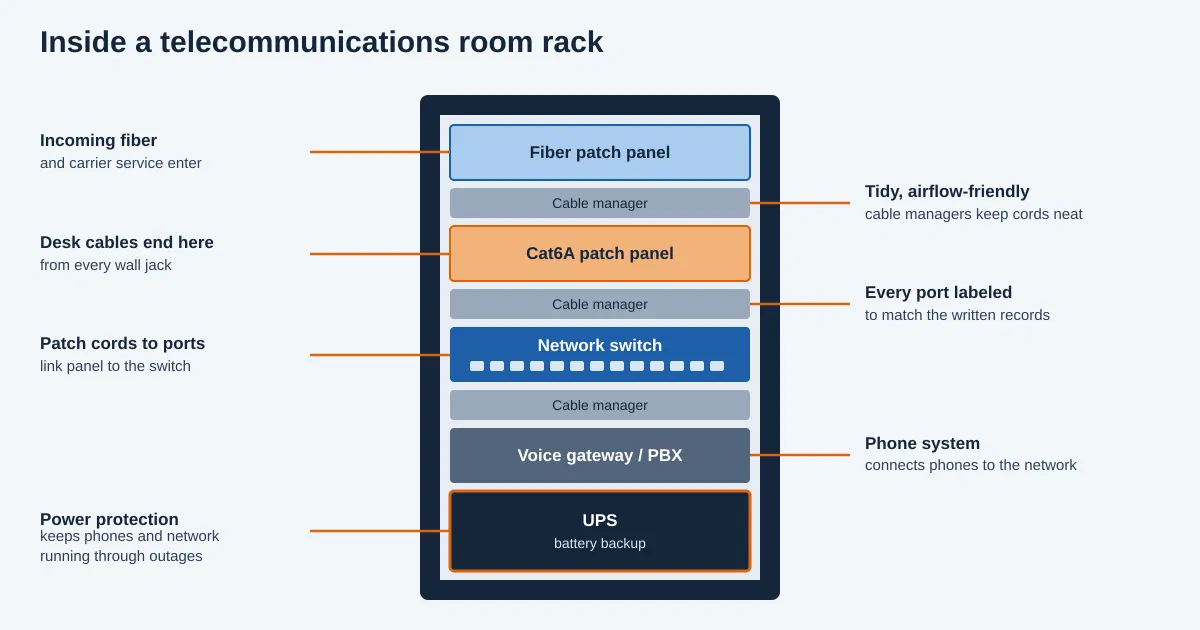
- Racks and enclosures: Equipment mounts in standard racks or wall-mounted cabinets that keep everything supported, reachable and organized.
- Patch panels: Permanent cables end on the panel, and short patch cords connect the panel to the switch, so changes never disturb the cable inside the wall.
- Cable management: Horizontal and vertical managers keep cords tidy and airflow clear, and they make it easy to trace and replace a connection.
- Power and backup: Dedicated circuits and a battery backup (UPS) keep phones and the network running through short outages and let equipment shut down safely during long ones.
- Cooling and ventilation: Network equipment produces heat, and closets without airflow can overheat, shortening equipment life and causing outages.
- Security and access: A locked door keeps the equipment safe from accidental or deliberate tampering.
- Grounding and bonding: Proper grounding protects equipment and people, and it is part of a compliant telecom room.
- Space for growth: Room for extra racks, panels and switches means the closet does not become crowded within a few years.
See our IT room build out and data center build out services for more on equipment rooms.
Voice, VoIP and Business Phone System Cabling
- VoIP phones: Internet-based phones plug into the same Cat6 or Cat6A cabling as computers, and many are powered through the cable with Power over Ethernet. This means one cable per desk can serve both the phone and the computer.
- Traditional and hybrid phone systems: Older PBX systems and hybrid setups may need separate voice cabling or gateways that connect analog lines to the network, so the phone system choice should be made before cabling is planned.
- Analog and special-purpose lines: Fax machines, alarm dialers and elevator emergency phones often use analog or dedicated lines, which need their own planning and carrier coordination.
- Conference and paging systems: Conference room phones, speakers and overhead paging need dedicated runs and sometimes extra equipment, and their locations should be set with the room layout.
- Carrier handoff: Phone lines and SIP trunks arrive from the carrier at the demarc, and the path from there to your voice equipment has to be cabled and documented.
- Quality of service: Voice is sensitive to delay, so a well-cabled network with properly configured switches keeps calls clear when the network is busy.
Our team works alongside your phone vendor and IT partners to make sure the cabling matches the system you choose. Contact us to discuss business telephone system cabling for your office.
Telecommunications Cabling Challenges in NYC Buildings
- Building rules: Many buildings require certificates of insurance, approved contractors and advance scheduling. Missing paperwork can keep a crew out of the building, so a contractor who handles this early keeps your project on schedule.
- Freight elevators: Cable reels, racks and tools often have to be booked through building management, with limited time slots, so deliveries must be planned around them.
- Carrier access and entrance facilities: Which providers serve a building and where their service enters can limit your options and your schedule, so it is worth confirming before you sign a lease.
- Shared risers and shafts: Connections between floors often use building-controlled risers where space is limited and access may need landlord approval.
- Older buildings: Pre-war construction can have thick walls, crowded conduits and abandoned cable, so routes must be surveyed before cable is pulled.
- After-hours work: Some buildings only allow disruptive work in the evening or on weekends, which affects scheduling and sometimes cost but keeps tenants undisturbed.
- Fire-rated spaces: Cable in air-handling spaces generally needs a plenum rating, and openings through fire-rated walls and floors must be firestopped under local codes.
Our Telecommunications Cabling Installation Process
- Site survey and consultation: We visit your space to review your floor plan, headcount, systems and building requirements, and we ask which areas have problems today and how much you expect to grow, so the design fits your business.
- Cabling design and quote: You receive a clear layout showing outlet locations, cable types, pathways and telecom room plans, with a transparent written quote so you know the scope and cost before work begins.
- Building coordination: We work with your property manager on access, insurance paperwork, freight elevator use, riser access and scheduling. Handling these early helps avoid delays on installation day.
- Cable installation: Our technicians run cable through ceilings, walls and risers, supported neatly and rated for each space, while keeping your workspace clean and minimizing disruption.
- Termination and equipment setup: Each cable is terminated at the jack and the patch panel, and racks, panels and cable management are set up in the telecom room.
- Testing: Every connection is tested for speed and reliability before handover. Any run that does not perform as it should is corrected before the job is considered complete.
- Labeling and documentation: Every cable, jack and port is labeled, and you receive records of what was installed. We can also help with later moves, adds and changes as your business grows.
For larger projects, our low voltage cabling design-build, low voltage cabling installation and project management services keep planning, installation and scheduling under one team.
Testing, Labeling and Documentation
- Copper testing: Each copper run is tested for wiring correctness and performance, which catches bad terminations, damaged cable and runs that are too long while they are still easy to fix.
- Fiber testing: Fiber links are checked for signal loss, and longer runs are often checked with an OTDR that shows where loss or reflection occurs.
- Consistent labeling: Every outlet, cable end and patch panel port gets a matching label, so any connection can be identified at either end in seconds.
- As-built drawings: You receive floor plans showing where each outlet and cable run actually ended up, which is often different from the original plan.
- Test results and port lists: Saved results and a list of every port give your IT team a baseline to compare against if a problem appears later.
- Handover walkthrough: A final review confirms that the work matches the plan, the telecom room is tidy and the records are complete.
Standards and Codes That Apply
Professional telecommunications cabling follows recognized standards. Organizations such as BICSI and the Telecommunications Industry Association (TIA) publish the guidance that structured cabling design is built on. The ANSI/TIA-568 family covers commercial building cabling, ANSI/TIA-569 covers pathways and spaces, ANSI/TIA-606 covers labeling and administration and ANSI/TIA-607 covers grounding and bonding. Electrical codes such as NFPA 70, the National Electrical Code, cover communications and optical fiber cable in buildings, including the ratings for ceilings and risers. For fiber work, the Fiber Optic Association (FOA) offers reference material. Local requirements may add more, so check with your building management and the New York City Department of Buildings.
What Affects the Cost of Telecommunications Cabling in NYC?
- The number of outlets and the systems connected: Each outlet needs a cable run, a termination and testing, so cost rises with the count. Adding phones, cameras, card readers and meeting room equipment adds runs and planning time, and spare outlets are cheaper to include now than to add later.
- Cable type and jacket rating: Cat6A costs more than Cat6 for both cable and labor, fiber is priced separately and plenum-rated cable costs more than riser or general-purpose cable.
- Building construction and route difficulty: Open ceilings are quick to work in. Hard ceilings, concrete, masonry walls and crowded pathways take more labor, so the same outlet count can cost very different amounts in different buildings.
- Telecom room build-out: A small office may need only a wall-mounted cabinet, while a larger one needs racks, panels, power, cooling and cable management.
- Backbone and demarc extension: Linking floors or extending carrier service from a distant demarc adds cable, labor and coordination with building risers and carriers.
- Testing and documentation level: More detailed testing and drawings take more time but give you stronger records.
- Building rules, after-hours work and insurance: Work limited to evenings or weekends, insurance certificates and booked elevator time all add scheduling effort and sometimes cost.
- Schedule pressure: A tight move-in date may need more technicians or extra hours, so starting early helps control cost.
The most reliable way to get an accurate figure is a site survey followed by a detailed written quote. Contact our team to start that conversation.
Signs Your Office Needs a Telecommunications Cabling Upgrade
- Poor call quality on VoIP phones: Echo, choppy audio and dropped calls often trace back to faulty cabling, old switches or an overloaded network.
- Slow or unstable network connections: Files that take minutes to open and video calls that freeze suggest weak links between the switch and the desk.
- Old Cat3 or Cat5 cabling: Older cable was built for much slower networks and may limit your speed no matter how fast your internet plan is.
- Not enough outlets: Staff sharing jacks with splitters or small desktop switches have outgrown their cabling.
- A messy or overheating telecom closet: Tangled, unlabeled cables make every repair slow, and a hot closet shortens equipment life.
- Cable running across floors or walls: Loose cable is a trip hazard and is easily damaged, and it usually means outlets are missing where people sit.
- No records of what is installed: If nobody knows where cables go, every change becomes guesswork and every fault takes longer to find.
Spotting two or three of these signs is a good reason to book an assessment. A professional can test your existing cabling and tell you whether you need a small fix or a full upgrade.
Common Telecommunications Cabling Mistakes to Avoid
- Installing too few outlets. Adding jacks later costs more than planning extra ports up front, because each addition means another visit and often more building paperwork.
- Choosing the wrong jacket rating. Cable that is not rated for the space can fail inspection and force rework.
- Choosing the cheapest cable. Low-quality cable can cause slow speeds and failures, especially with PoE devices, and the savings disappear in repairs and downtime.
- Skipping testing. Untested cabling often hides faults that only appear later. Testing every run before handover catches problems while they are easy to fix.
- No labeling or documentation. Unlabeled ports turn small changes into long troubleshooting sessions.
- Undersizing the telecom room. Small, hot or crowded closets cause problems for years, so plan space, power and cooling for growth.
- Ignoring building and carrier lead times. Approvals, riser access and carrier installation can take weeks, so start early to protect your move-in date.
- Hiring too late. Bring a cabling contractor in during design, not after build-out, because once ceilings are closed every run is harder and more expensive.
How to Choose a Telecommunications Cabling Contractor in NYC
- Ask about standards. A good contractor designs to recognized structured cabling standards and can explain how they apply to your space.
- Ask about testing. Every run should be tested, with results available on request, because untested cabling can hide faults that show up weeks later.
- Ask about labeling and documentation. You should receive clear records at handover, since they save time and money on every future change or repair.
- Check building experience. Familiarity with Manhattan insurance, elevator, riser and work-hour rules avoids delays that could push back your move-in date.
- Look for breadth. One contractor who can handle voice, data, security and audio/video avoids coordination problems and keeps responsibility in one place.
- Ask about phone system coordination. The contractor should be willing to work with your phone vendor and IT partners so the cabling matches the system.
- Get a written scope and quote. It should list cable types, outlet counts, equipment and schedule, which prevents surprises and lets you compare bids fairly.
- Check support after the job. Moves, adds and changes will come up, so ask who handles them and how quickly they respond.
Want to see how other clients feel about working with us? Read and leave reviews on Yelp, or read more tips on our blog.
Why Choose New Tech Cabling for Telecommunications Cabling in NYC?
- Local knowledge of Manhattan commercial buildings: We are based in Midtown Manhattan and know the access, insurance and scheduling requirements buildings commonly set.
- Experience across voice/VoIP, data, security and audio/video cabling: One team can plan phones, computers, cameras and conference rooms together on one organized infrastructure.
- Clean, labeled and well-documented work: Tidy routing, labeled ports and clear records make your network easy to support and change later.
- Transparent quotes and clear communication: You receive a written scope and price before work begins and stay informed about schedule and progress.
- Support for moves, adds and changes: When your team grows or you rearrange the office, we can extend or change the system, including relocations, without starting over.
Telecommunications Cabling Service Areas in New York
New Tech Cabling is located in the heart of Midtown Manhattan, at the corner of 5th Avenue and 34th Street. We serve businesses and buildings throughout Manhattan, including Midtown, the Financial District, Chelsea, SoHo, Tribeca, Hudson Yards and the Flatiron District, as well as Brooklyn, Upper Manhattan, Jersey City, Hoboken and Union City.
Frequently Asked Questions About Telecommunications Cabling in NYC
What is telecommunications cabling?
It is the structured system of cables, jacks, panels, racks and pathways that carries voice, data and other signals through a building, installed to recognized standards and documented for future changes.
How much does telecommunications cabling cost in NYC?
Cost depends on the number of outlets, cable type and rating, building construction, telecom room needs and building rules. A site survey followed by a written quote is the most reliable way to get an accurate figure.
Is telecommunications cabling the same as network cabling?
They overlap. Telecommunications cabling is the broader term and includes voice, data, video and security cabling, while network cabling usually refers to the data part. In a modern office they are installed as one structured system.
Do VoIP phones need special cabling?
Usually not. VoIP phones normally use the same Cat6 or Cat6A cabling as computers, and many are powered through the cable, so the main need is enough outlets and a switch that supports Power over Ethernet.
What is a demarc and why does it matter?
The demarc, or demarcation point, is where the carrier’s service ends and your cabling begins. If it is far from your telecom room, a demarc extension carries the service to your equipment, and it should be planned early.
What cable rating do I need above the ceiling?
Ceiling spaces used for air return generally require plenum-rated cable, but requirements depend on the building and local code, so confirm with your building management and installer.
How long does a telecommunications cabling installation take?
Small offices are often completed in one to two days of installation. Larger or multi-floor projects take longer, and planning, approvals and scheduling add time before installation begins.
Can you work in an occupied office?
Yes. We plan the work to minimize disruption to your team and to follow your building’s rules, including after-hours scheduling where required.
Do you test and document the cabling?
Yes. Every connection is tested and labeled, and you receive documentation of what was installed.
Which areas do you serve?
We serve Manhattan, Brooklyn, Upper Manhattan, Jersey City, Hoboken and Union City.
Request a Telecommunications Cabling Quote in NYC
Ready for cabling your business can rely on? Contact New Tech Cabling for telecommunications cabling in NYC. Our team will assess your space, recommend the right solution and deliver clean, tested and documented work.
Call (212) 537-5965 | Schedule a consultation
Email: info@newtechcabling.com
Hours: Monday to Friday, 7:00 am to 6:00 pm
Location: 5th Avenue and 34th Street, Midtown Manhattan, New York
Learn more: Network installations | All services | Low voltage cabling installation | New Tech Cabling home
Recent Comments