Audio Visual Cabling Manhattan: A Straightforward Guide to Getting It Right the First Time
What’s Covered in This Guide
- Why Audio Visual Cabling Matters More Than People Think
- What Audio Visual Cabling Actually Involves
- Features That Separate a Good Install from a Bad One
- Feature Comparison: DIY vs. Handyman vs. Licensed AV Contractor
- Our Workflow, Start to Finish
- Quick Facts Table
- Get a Free Quote
- Frequently Asked Questions
Why Audio Visual Cabling Matters More Than People Think
Here’s the thing most people don’t realize until it’s too late: the projector, the speakers, the conference camera — none of that gear is the problem when things go wrong. It’s almost always the cabling behind it. A loose connector, an unshielded run sitting too close to a fluorescent ballast, or a cable that’s simply too long for the signal it’s carrying. Any one of those can turn a $10,000 AV setup into a source of constant frustration.
That’s exactly why Audio Visual Cabling Manhattan searches have grown so much lately. Property managers, IT directors, and business owners have learned the hard way that hiring someone to “just run a few wires” almost never ends well. Buildings here are older, walls are denser, and conduit runs often have to share space with electrical, fire, and security systems. Getting the routing right the first time isn’t a nice-to-have — it’s what keeps your system reliable for years instead of months.
On top of that, Manhattan commercial leases rarely give you a second chance to tear open a finished wall. So when a job gets done properly the first time, it saves real money down the line, not just headaches.
What Audio Visual Cabling Actually Involves
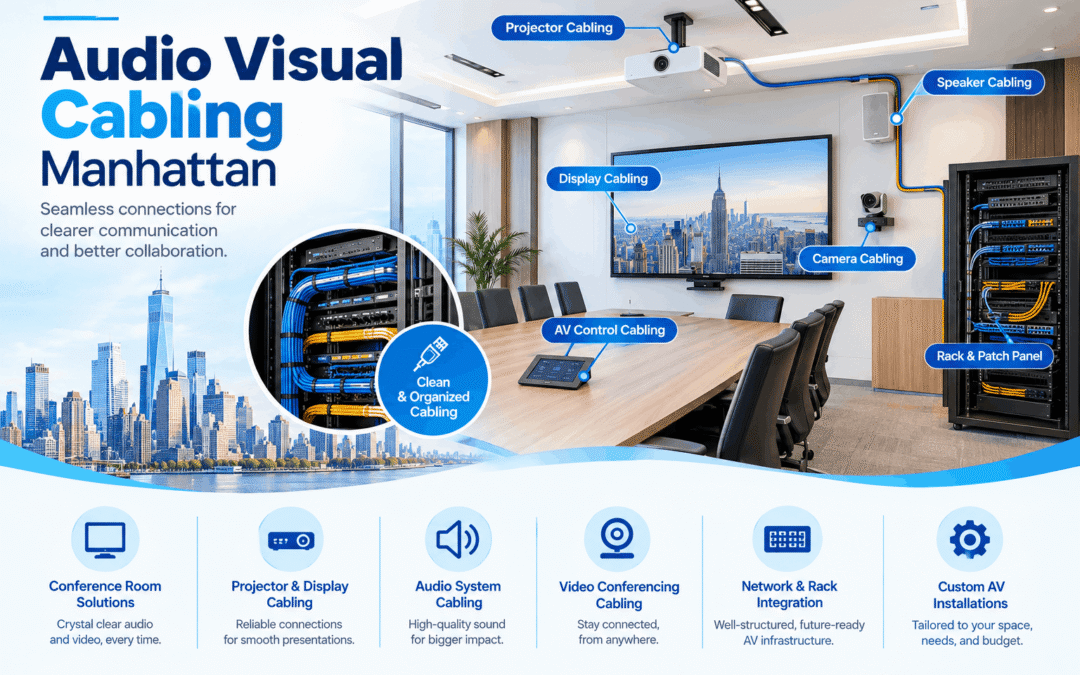
At a basic level, audio visual cabling covers every cable that connects your AV components together and back to your control system. That includes:
- HDMI, HDBaseT, and fiber optic runs for video signal
- Speaker wire and balanced audio cabling for sound systems
- Control cabling for touch panels, projectors, and automated systems
- Cat6/Cat6A runs that carry AV-over-IP signals for conference rooms
- Conduit and pathway planning so cables aren’t just draped across a ceiling
It sounds simple written out like that, but the planning stage is where most of the real work happens. Before a single cable gets pulled, a contractor who knows what they’re doing will map out signal distances, check for interference sources, and confirm the building’s fire code requirements — plenum-rated cable is non-negotiable in most Manhattan commercial spaces. Skip that step, and you’re setting yourself up for a failed inspection or, worse, a fire hazard nobody catches until it’s a problem.
If your project also touches your building’s data backbone, it’s worth reading our breakdown of what to look for in a network cabling contractor in NYC — a lot of AV-over-IP installs lean directly on that same infrastructure, so the two jobs often overlap more than people expect.
Features That Separate a Good Install from a Bad One
- Clean Labeling — Every cable tagged and documented, so the next technician — or you — isn’t guessing which wire goes where.
- Code-Compliant Materials — Plenum-rated jacketing and proper fire-stopping wherever cables pass through walls or ceilings.
- Future-Proof Pathways — Conduit sized with room to spare, so adding a device later doesn’t mean opening the wall again.
- Signal Testing — Every run tested before we walk away, not just at the moment the gear turns on.
- Low-Voltage Coordination — AV cabling planned alongside your low-voltage systems instead of as an afterthought.
- Documentation on Handoff — As-built diagrams and cable schedules delivered with every completed project.
This kind of attention to detail is also why so many clients ask us about low-voltage cabling in Manhattan once their AV project wraps up — once you see how a properly documented system holds up, it’s hard to settle for anything less on the rest of the building.
Feature Comparison: DIY vs. Handyman vs. Licensed AV Contractor
| Factor | DIY / In-House Staff | General Handyman | Licensed AV Contractor (NewTech Cabling) |
|---|---|---|---|
| Code Compliance | Rarely checked | Inconsistent | Always confirmed against local fire & building code |
| Cable Labeling & Documentation | Usually skipped | Sometimes | Standard on every job |
| Signal Testing Before Handoff | Not done | Rarely | Always, with test results shared |
| Warranty on Workmanship | None | Limited or none | Included |
| Experience with Manhattan Buildings | Varies | Varies | Extensive, older buildings included |
| Long-Term Reliability | Low | Moderate | High |
Our Workflow, Start to Finish
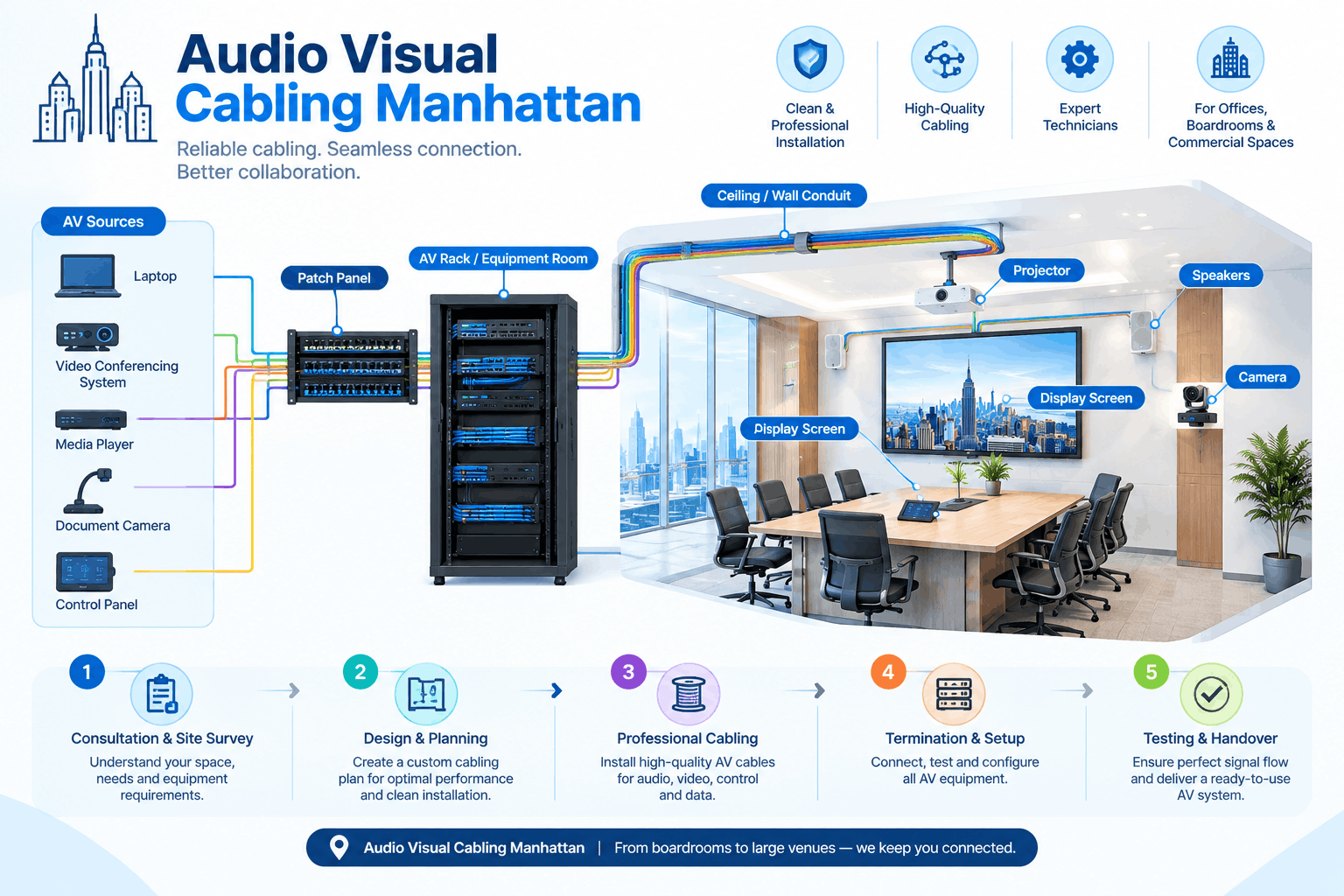
- 1. Site Walkthrough & Signal Planning — We assess the space, map cable routes, and identify anything that could interfere with signal quality.
- 2. Design & Material Selection — We choose the right cable types and lengths for the distances involved, keeping code compliance in mind from the start.
- 3. Cable Pulls & Termination — Cables are run through conduit or plenum spaces, terminated cleanly, and labeled as we go — not afterward.
- 4. Testing & Signal Verification — Every run is tested for continuity and signal strength before we call the job finished.
- 5. Documentation & Handoff — You get as-built drawings and a cable schedule, so future work is quick and painless.
Quick Facts Table
| Detail | Information |
|---|---|
| Service Area | Manhattan, New York, NY |
| Service Type | Audio Visual Cabling, Low-Voltage Cabling, Network Cabling |
| Typical Turnaround | Project-dependent, usually 1–2 weeks for standard office builds |
| Cable Types Used | HDMI, HDBaseT, Fiber, Cat6/6A, Speaker Cable |
| Compliance | NEC & local fire code, plenum-rated materials |
| Free Quote | Contact us |
Ready to Get Your AV Cabling Done Right?
Tell us about your space and we’ll put together a clear, no-pressure quote — usually within a day or two.
Frequently Asked Questions
It really depends on the size of the space, how many rooms are involved, and whether existing conduit can be reused. A single conference room usually costs far less than a full-floor rollout. We give exact numbers after a site walkthrough rather than guessing over the phone. Our core focus is the cabling and infrastructure side — the part that has to be right before any equipment goes in. We coordinate closely with AV integrators and, in many cases, handle both under one project timeline. Yes, and honestly, that’s most of what we do. Older buildings need more creative pathway planning, but that’s exactly where experience matters most. A single conference room can often be done in a day or two. Larger commercial buildouts usually run one to two weeks, depending on access and how many floors are involved. In most commercial Manhattan buildings, yes — anywhere cable runs through an air-handling space. We confirm this during the site walkthrough so there are no surprises during inspection.Do you handle both the cabling and the AV equipment installation?
Can you work in older Manhattan buildings with limited conduit access?
How long does a typical AV cabling project take?
Is plenum-rated cable required for my project?
Whether you’re outfitting one meeting room or an entire office floor, the goal is the same: cabling that just works, year after year, without you having to think about it. That’s what proper Audio Visual Cabling Manhattan planning gets you — and it’s exactly what we build every time.
Recent Comments