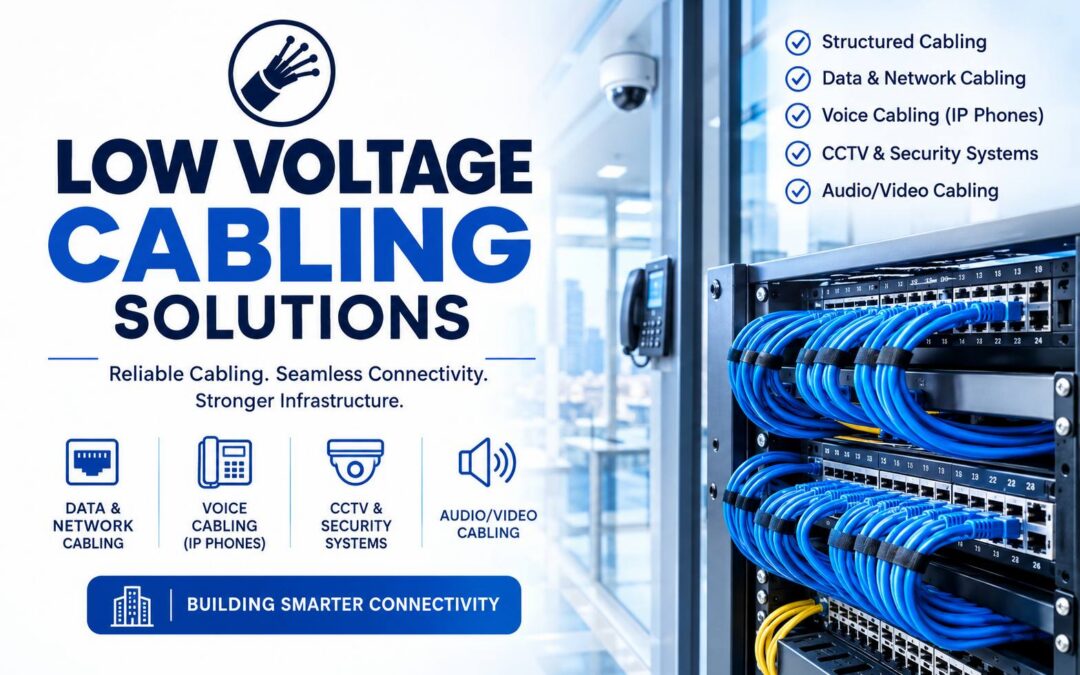
Everything a Manhattan business owner needs to know about low-voltage cabling — what it is, why it matters, and how to plan an installation that keeps your office connected for years to come.
If you have ever opened a ceiling tile or a server closet and seen a tangle of thin cables running between routers, cameras, and phones, you have already seen low-voltage cabling at work. For business owners across Manhattan, understanding this infrastructure is no longer optional — it is the backbone that keeps internet, phones, security systems, and audiovisual equipment running smoothly every single day.
In this guide, we break down what it is, the different types available, why it matters for commercial buildings in a dense market like NYC, and how to plan an installation the right way.
What Is Low-Voltage Cabling?
It refers to any wiring that carries 50 volts or less — far below the current used to power lights, outlets, or heavy equipment. Instead of delivering electrical power, this type of cabling carries data, voice, video, and control signals. In practice, what connects your computers to the internet, your phones to each other, your cameras to a recorder, and your access control system to the front door.
Because it carries signal rather than power, it is safer to install, easier to route through walls and ceilings, and far more flexible than traditional electrical wiring. Cable types and terminology are standardized industry-wide by organizations such as the Telecommunications Industry Association (TIA), whose TIA-568 standard governs most structured cabling installed in commercial buildings today.
Why Low-Voltage Cabling Matters for Manhattan Businesses
Manhattan office space comes at a premium, and buildings are often older, tightly packed, or shared between multiple tenants. That makes a clean, well-planned cabling system even more valuable. A properly installed system:
- Reduces downtime by keeping network, phone, and security infrastructure organized and easy to troubleshoot.
- Supports growth, since a scalable low-voltage cabling layout makes it far easier to add desks, cameras, or access points later.
- Improves safety compared with high-voltage runs, since the cable itself carries minimal current.
- Keeps landlords and building management happy, since NYC commercial buildings often have strict rules on how cabling is run through shared risers and plenums.
Common Types of Low-Voltage Cabling
Not all low-voltage cabling is the same. The right choice depends on the systems you’re running and how far signals need to travel through your space.
Ethernet (Cat5e / Cat6 / Cat6a)
The standard for office networks, phones, and Wi-Fi access points. Cat6a is increasingly the default choice for new Manhattan office buildouts because it supports faster speeds over longer distances.
Fiber Optic Cable
Used for high-speed backbone connections between floors or buildings, or wherever electrical interference or long distances make copper cabling impractical.
Coaxial Cable
Still common for cable television distribution and some legacy security camera systems in older commercial spaces.
Security & Access Control Cable
Dedicated runs for cameras, door access readers, and alarm panels, often combined with Power over Ethernet (PoE) to simplify installation.
What Systems Rely on Low-Voltage Cabling?
Most business owners are surprised to learn just how many everyday systems depend on low-voltage cabling behind the scenes:
- Office internet and Wi-Fi networks
- VoIP phone systems
- Security cameras and access control (see our security systems cabling services)
- Conference room audiovisual equipment
- Point-of-sale systems in retail and hospitality
- Building automation, including smart lighting and thermostats
Planning a buildout or renovation in Manhattan? A structured low-voltage cabling plan drawn up before drywall goes in will save significant time, cost, and rework later. Learn more about our low-voltage cabling installation services.
Low-Voltage Cabling vs. High-Voltage Wiring
Business owners sometimes confuse low-voltage cabling with the electrical wiring that powers their outlets and lighting. The two serve very different purposes:
- High-voltage wiring powers equipment, lighting, and outlets, and requires a licensed electrician for any work, per National Electrical Code (NEC) requirements.
- Low-voltage cabling carries data and signal, and is typically installed by a specialized structured cabling contractor rather than a general electrician.
In most Manhattan commercial buildings, both trades work side by side during a buildout, but low-voltage cabling is where the actual performance of your network, phones, and security systems is decided.
Choosing a Low-Voltage Cabling Installer in Manhattan
Because commercial space in NYC is dense, older buildings often have limited riser space, strict landlord requirements, and fire-code rules around cable jacketing (such as plenum-rated cable). When evaluating a provider for low-voltage cabling, look for:
- Experience working in Manhattan commercial buildings and knowledge of local building requirements
- Clear labeling, testing, and documentation for every cable run
- Ability to support multiple systems — network, phone, security, and AV — under one project
- Willingness to plan for future scalability, not just today’s needs
Frequently Asked Questions
What voltage range counts as low-voltage cabling?
It generally refers to wiring that carries 50 volts or less, which covers most Ethernet, phone, security, and AV cabling used in commercial buildings.
Do I need a permit for low-voltage cabling in Manhattan?
Requirements vary by building and scope of work. Many landlords and building management offices have their own rules for cabling in shared risers and ceilings, so it’s worth checking with your building before work begins.
How long does a typical office low-voltage cabling installation take?
A small office refresh might take a few days, while a full-floor buildout in a Manhattan commercial space can take several weeks depending on the number of drops, riser access, and coordination with other trades.
Can this type of cabling support both my network and security cameras?
Yes. Modern Ethernet-based cabling, combined with Power over Ethernet (PoE), can carry both data and power to cameras, access control readers, and wireless access points over the same cable type.
How do I get a quote for low-voltage cabling for my Manhattan office?
Reach out with your address, approximate square footage, and the systems you need (network, phone, security, AV) to get a site assessment and quote.
Planning a Low-Voltage Cabling Project in Manhattan?
Get a site assessment and a clear plan for your office network, phones, security, and AV cabling. Contact New Tech Cabling to schedule a consultation.
Recent Comments